Water filtration
Water Filter Bottles: What Buyers Should Check
Review water filter bottles and portable filters by intended water source, verified treatment claims, replacement parts, maintenance and packaging.
In this guideDistinguish filtration from purification
A bottle, straw or gravity filter can look simple while making very different treatment claims. For buyers, the central task is to match the intended water source and user needs with documented product capabilities. Neither clear-looking water nor an attractive filter housing establishes that water is safe to drink.
Distinguish filtration from purification
Filtration describes a treatment process. The contaminants it can reduce depend on the complete system and its demonstrated performance. Purification is a stronger product claim that requires supporting evidence for the hazards addressed. The words should not be treated as interchangeable descriptions of any portable filter.
CDC notes that portable filters do not remove every type of germ and advises users to follow the filter instructions and its emergency water treatment guidance. A filter’s pore-size number alone is not a complete statement of drinking-water safety.
When evaluating products marketed as purifiers, request the applicable test report, standard or protocol, named contaminants, and tested model. LifeSaver, for example, publishes product-specific treatment information for its Bottle Water Purifier. Those results cannot be transferred to another product with similar styling or a smaller advertised pore size.
Write down the intended source
Specify whether the product is intended for treated tap water, outdoor freshwater use or another clearly defined application. Then review the manufacturer’s permitted uses and exclusions. A bottle designed to improve the taste of treated water may have no documented role in treating untreated surface water.
Do not describe a portable filter as making any water drinkable. CDC advises using bottled water or another source when fuel or toxic chemical contamination is known or suspected; ordinary household treatment is not a universal solution. See its household water treatment guidance.
Avoid implying seawater desalination, chemical removal or virus reduction unless the exact system has evidence for that function. Keep these distinctions in the buying specification and any customer-facing instructions.
Request a complete specification
Use a comparison sheet that separates container details from treatment details.
| Field | What to verify |
|---|---|
| Product format | Bottle, straw, inline filter or gravity configuration |
| Water capacity | Container volume, distinct from treatment capacity |
| Filter system | Identified filter media and replaceable components |
| Treatment claims | Named contaminants, test method and model-specific evidence |
| Service life | Stated limit and conditions that affect replacement |
| Connections | Bottle threads, hoses, bags and included adapters |
| Care | Cleaning, storage, first-use and replacement instructions |
Ask whether a lifespan figure is a maximum under specified conditions. Turbidity, source water and care may affect practical use. Do not turn a claimed treatment volume into a guaranteed number of years without an appropriate basis.
Check the whole user workflow
Evaluate a sample with its supplied instructions. Identify the untreated-water side, treated-water outlet and storage arrangement. Check whether caps, hoses and accessories can be kept organized without placing the drinking outlet against dirty components.
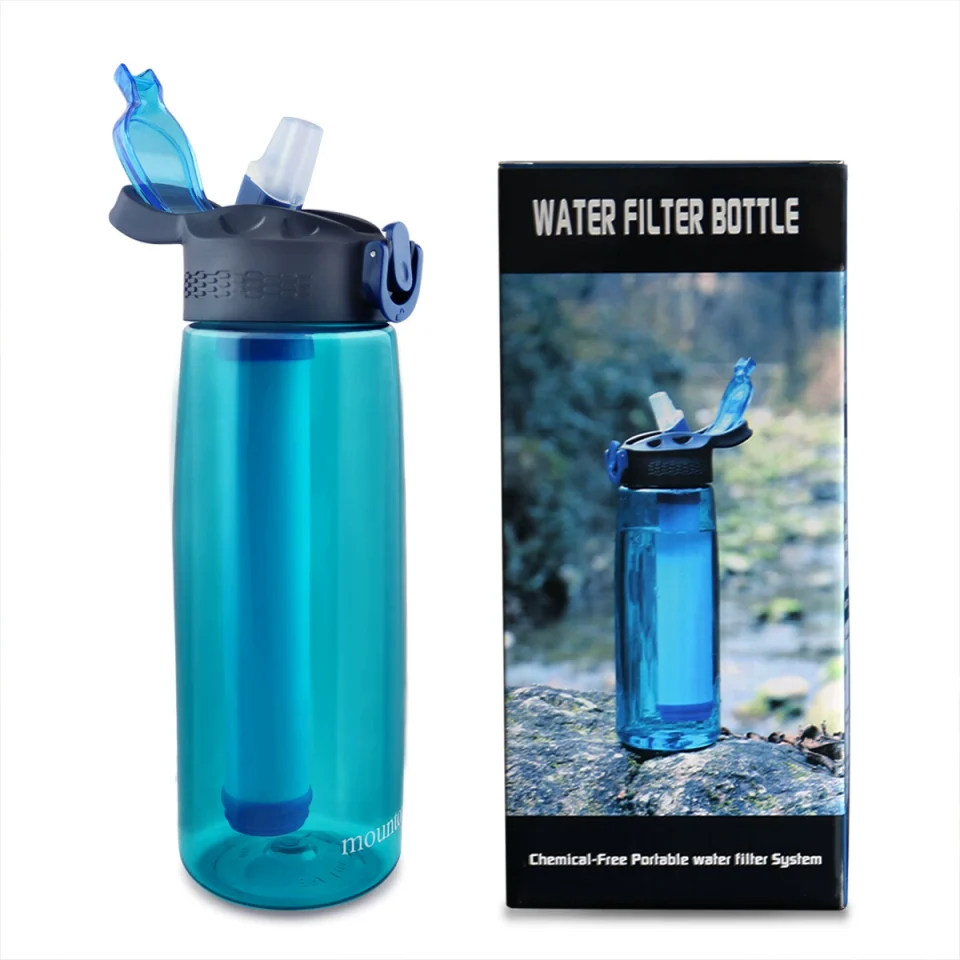
For a bottle, assess filling access, carrying method and replacement-filter access. For a gravity kit, check the supplied bag, hose and connections as a complete assembly. Do not infer compatibility from a photograph of a filter screwed onto a bottle; confirm the specified thread or adapter.
Review the manufacturer’s cleaning and storage requirements, including any temperature restrictions. Ask how users recognize a blocked, damaged, or exhausted filter, and confirm which replacement parts are available. Clear care instructions are part of a usable product, especially when kits may sit in storage before distribution.
Keep the order and retail description aligned
Approve the exact model, accessory list, packaging and instructions together. If the proposed configuration changes, review whether the supporting documents still apply. Confirm that any report identifies the supplied filter rather than a different cartridge or family member.
Browse our water and hydration products to compare available configurations. For a bulk sourcing inquiry, send us your intended application, quantity, destination, and technical documentation requirements to request a quotation.